
If you found rough, red patches on your baby's cheeks and have been searching for answers ever since, take a breath. Eczema is one of the most common skin conditions in babies and young children, and a consistent home routine can help keep skin comfortable.
When parents search for baby eczema treatment, they usually need two things: a gentle daily skincare routine at home, and medical treatment from their pediatrician when a flare needs more. At EllaOla, we formulated our eczema-friendly skincare collection to cleanse and moisturize eczema-prone skin as part of that daily routine.
This guide covers how to spot eczema, the daily bath-and-moisturize routine our pediatric dermatologist recommends, what your pediatrician may prescribe, and when to call.
How to Spot Eczema in Babies and Kids
Eczema (atopic dermatitis) affects about 1 in 10 children in the US, and it often begins in the first six months of life. If your baby is in that group, nothing you did caused it. Genetics and a still-developing skin barrier do most of the work here.
Where it appears changes with age. In infants, patches favor the cheeks, forehead, scalp, and the outer arms and legs, while the diaper area is usually spared. In toddlers and older kids, eczema settles into the elbow and knee creases, wrists, ankles, and neck.
The patches feel dry and rough and look red on fair skin. On darker skin, eczema can look brown, gray, or purple instead, and patches may leave lighter or darker areas behind after a flare. During a flare, skin can also ooze or crust.
Itch is the telltale sign. Babies rub their face against sheets or your shoulder, sleep restlessly, and scratch at the crib. A family history of eczema, asthma, hay fever, or food allergies raises the odds. A pediatrician or dermatologist diagnoses eczema by how the skin looks and behaves; there is no single test.
Eczema vs. Common Look-Alikes
A few baby rashes get mistaken for eczema. Cradle cap shows up as greasy yellow scale on the scalp, doesn't itch, and usually clears on its own within a few months. For everyday scalp care, a soft baby hair brush keeps grooming gentle on a delicate scalp. Baby acne means small red bumps on the cheeks and nose around weeks two to six, again with no itch and no dry patches.
Drool rash sits on the chin and in neck folds and follows teething. It can also set off eczema on the face. Heat rash looks like tiny bumps in skin folds and covered areas, and it fades once your baby cools down.
A dry, itchy patch that keeps returning is worth showing your pediatrician. Several rashes can look similar, and your pediatrician can identify the cause and recommend appropriate care.
Daily Care for Baby’s Eczema-Prone Skin
Baby skin is thinner than adult skin, and its barrier is still developing, so it loses water faster and lets irritants in more easily. That's why moisturizing carries so much of the load with young kids.
Bathing
Our Harvard pediatric dermatologist, Dr. Jennifer Huang, recommends keeping baths under 10 minutes and bathing no more than once a day. Use lukewarm water, since hot water strips the skin. Use a fragrance-free, sulfate-free cleanser like our Superfood Baby Shampoo & Body Wash, and only where your baby needs it: skin folds and the diaper area.
For itchy, dry skin, a colloidal oatmeal soak is a gentle option; the FDA recognizes colloidal oatmeal as an over-the-counter skin protectant for itch and minor irritation. Skip bubble bath, scented products, and rough washcloths.

Our Organic Bath Soak blends colloidal oatmeal with coconut, decaffeinated black tea, Dead Sea salt, and prebiotics in a muslin pouch that doubles as a soft washcloth. It carries the National Eczema Association Seal of Acceptance and is formulated without fragrance or essential oils.
Dr. Huang recommends using the soak once a week, or up to twice a week when skin is dry or irritated, with no cleanser needed on soak days. Explore our bathtime essentials for the rest of the routine.
When the bath ends, pat skin dry and leave it slightly damp for the moisturizing step.

Moisturizing: Soak and Seal
Apply moisturizer right after the bath, while skin is still damp, to lock that water in. Pediatric dermatologists call this soak and seal. Dr. Huang recommends moisturizing from head to toe after every bath and reapplying to the face often, especially before feeding and bedtime. Include skin that looks fine, and add more whenever skin looks dry, diaper changes included.
Thicker formulas hold more water in. Ointments like petroleum jelly carry the most oil and suit active dry patches, though they feel greasy. Creams sit in the middle.

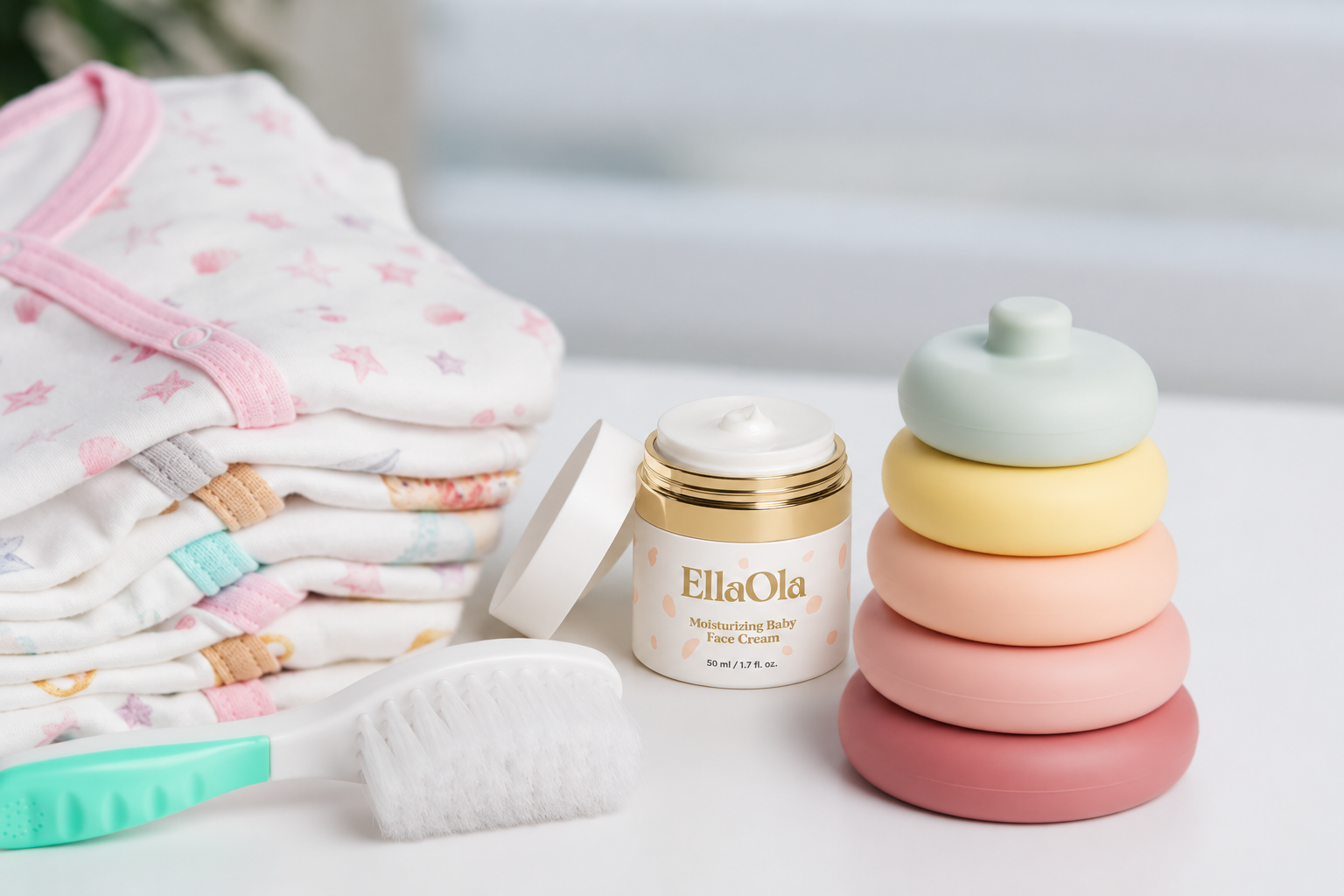
Lotions are the lightest choice and suit daily upkeep on skin that isn't flaring, warmer months, and school-age kids who refuse anything greasy. Our Hydrating Baby Lotion is made for that everyday role, and our Moisturizing Baby Face Cream covers drool-prone cheeks and chins. Both carry the National Eczema Association Seal of Acceptance.
If your doctor recommends an ointment for active patches, use it alongside these, and keep moisturizing even when skin looks clear. Keeping the routine going on good weeks helps.
Use more moisturizer than feels natural; most parents apply too little. Patch-test any new product on a small area for a day or two before using it all over.
Clothing, Nails, and Sleep
Dress your child in soft cotton or other breathable fabrics, and keep wool and scratchy synthetics off bare skin. Wash clothes in fragrance-free laundry detergent, run an extra rinse cycle, and skip dryer sheets.
Keep nails short, and try cotton mittens or scratch sleeves at night if scratching wakes your baby. Keep the bedroom cool and avoid overbundling, since sweat is one of the most common triggers.
Caring for Flare-Ups
A flare can bring increased itching, changes in skin color, and disrupted sleep. Continue the skincare routine your pediatrician recommends, and apply prescribed treatments in the order and amount directed. Contact your pediatrician promptly for new oozing, crusting, painful blisters, or a worsening rash, since these can be signs of infection.
Medical Treatment From Your Pediatrician
Over-the-Counter Hydrocortisone
One percent hydrocortisone is a mild steroid cream available without a prescription. Pediatricians sometimes suggest it for red, itchy patches, and the label says to stop and ask a doctor if symptoms last more than seven days.
The label also says not to use it on children under 2, or for diaper rash, unless a doctor directs you to. Ask your pediatrician before using it on your baby, including how to pair it with moisturizer.
Prescription Options
When over-the-counter care isn't enough, your pediatrician or a pediatric dermatologist can prescribe stronger options. These include prescription steroid creams matched to your child's age and the body area, several steroid-free prescription creams (some approved for babies as young as 3 months), and, for moderate-to-severe eczema that topical treatments haven't controlled, an injectable biologic approved from 6 months of age.
The American Academy of Dermatology strongly recommends topical steroids for children with eczema when used as directed. If side effects worry you, say so; those concerns are common and worth discussing with the prescriber. Some doctors also recommend a proactive plan for flare-prone spots between flares.
Wet Wraps and Bleach Baths
For severe flares, a doctor may walk you through wet wraps, which use damp cotton layers over the skin. For kids with repeated skin infections, a doctor may recommend dilute bleach baths and will give you the exact dilution and schedule.
Both are additions to a treatment plan under a doctor's guidance, and neither replaces daily moisturizing. Ask your pediatrician before trying either at home.
Common Triggers to Track
Fragrance, essential oils, harsh soaps, wool, chlorine, and sand irritate eczema-prone skin directly. Heat and sweat set off many kids, especially overnight. Dry air and indoor heating pull moisture from skin, so a humidifier in the bedroom can help during dry stretches.
Saliva and food residue around the mouth flare facial eczema during teething and when starting solids. Many pediatricians suggest a thin coat of plain ointment before meals to protect that area. Skin infections, usually staph, can trigger or worsen flares. In older kids, dust mites, pet dander, and pollen join the list.
You don't need to guess at your child's triggers. Keep a simple log of flare dates, new products, foods, weather, and sleep, and bring it to appointments. For more everyday habits, see our dermatologist tips for dry skin and eczema.
Food Allergies and Eczema
Many parents wonder whether milk or eggs caused the rash. Food is rarely the cause of eczema, though the relationship runs the other way: early, severe eczema raises the risk of developing a food allergy.
The American Academy of Pediatrics recommends introducing peanut-containing foods early. For babies with severe eczema or an egg allergy, that can be as early as 4 to 6 months, after a talk with your pediatrician, who may recommend allergy testing first. For babies with milder eczema, around 6 months is typical. Use an infant-safe preparation, such as smooth peanut butter thinned into a puree your baby already tolerates, once they are ready for solids. Do not offer whole peanuts or thick spoonfuls of peanut butter. For babies with severe eczema or an egg allergy, discuss the introduction plan with your pediatrician first.
Cutting foods on a hunch can leave nutrient gaps and rarely clears the skin, so skip elimination diets unless an allergy has been diagnosed. Hives, vomiting, or swelling after eating may indicate a food allergy and need prompt medical advice. For trouble breathing, tongue or throat swelling, collapse, or symptoms suggesting a severe allergic reaction, use prescribed epinephrine immediately and call 911.
If your family is already managing diagnosed food allergies, our kids' supplements are formulated free from the top 9 common food allergens, and our guide to vitamins for kids with food allergies covers the options. They help fill everyday nutritional gaps and are not eczema products.
Oils, Probiotics, and Vitamin D: What Parents Ask About
Some parents try coconut oil, which isn't an option for a child with a coconut allergy. Our Hydrating Baby Lotion, Moisturizing Baby Face Cream, Organic Bath Soak, and Superfood Baby Shampoo & Body Wash all contain coconut too, so skip them for a child with that allergy.
Research on plain oils for eczema in babies is limited, and an oil doesn't replace the bath-and-moisturize routine above. Breast milk on the skin, apple cider vinegar, and essential oils have thin evidence behind them, and some can irritate. If baby massage is part of your bedtime routine, our organic baby oil is fragrance-free and can be followed by your usual moisturizer.
The probiotic evidence is mixed. A 2015 World Allergy Organization guideline conditionally suggested probiotics during pregnancy, breastfeeding, and infancy in families at high allergy risk, mainly for eczema prevention, on very low-certainty evidence.
The American Academy of Dermatology's 2026 pediatric guidelines recommend against probiotic supplements for preventing eczema. No probiotic replaces daily skincare.
We make an Unflavored Digestive Pre+Probiotic as a daily supplement that supports kids' digestive health. It is not an eczema product.
Vitamin D comes up because levels dip in winter. In one small randomized trial of 107 children in Mongolia, where winter vitamin D deficiency is common, a month of daily vitamin D improved winter-related eczema.
That result may not apply to kids with normal levels, and the same 2026 guidelines recommend against vitamin D supplements for preventing eczema. Check levels with your pediatrician before adding a supplement.
When to Call the Pediatrician
Call your pediatrician right away or seek urgent care for yellow crusts, pus, spreading redness, or fever, which point to infection, or for clusters of small, painful, punched-out blisters or sores, a possible sign of eczema herpeticum. For a suspected food reaction, follow the guidance in the Food Allergies and Eczema section above, including emergency action for a severe reaction.
For diagnosed eczema, contact your pediatrician if the agreed care plan is not helping. Do not wait a week for a new or worsening rash, possible infection, or any of the following:
-
Itch that keeps disrupting your baby's sleep, or the whole family's
-
Eczema covering large areas, or a new rash in a baby under 3 months.
-
For a baby under 3 months, a temperature of 100.4°F (38°C) or higher requires immediate medical advice, whether or not there is a rash.
-
Poor weight gain
Bring notes to the visit: when the rash started, where it shows up, which products you've used, and your flare log. Those details help your pediatrician sort eczema from its look-alikes quickly.
Does Baby Eczema Go Away?
According to the American Academy of Pediatrics, eczema starts to go away by around age 4 for some children, though others keep dry, sensitive skin as they grow up. A consistent routine helps keep skin comfortable between flares.
Some kids with eczema go on to develop food allergies, asthma, or hay fever, a progression doctors call the atopic march. It's far from guaranteed.
Caring for Eczema-Prone Skin, Day by Day
Eczema care comes down to a routine you can run on autopilot: a short lukewarm bath, moisturizer right after, cotton next to the skin, and a trigger log on the fridge. During a flare, follow your pediatrician’s treatment plan, including the instructions for applying medication and moisturizer.
Start tonight with the bath and the moisturizer, and explore our eczema-friendly skincare collection for the products that fit each step. Call your pediatrician if the patches are new, spreading, showing signs of infection, or costing your family sleep.