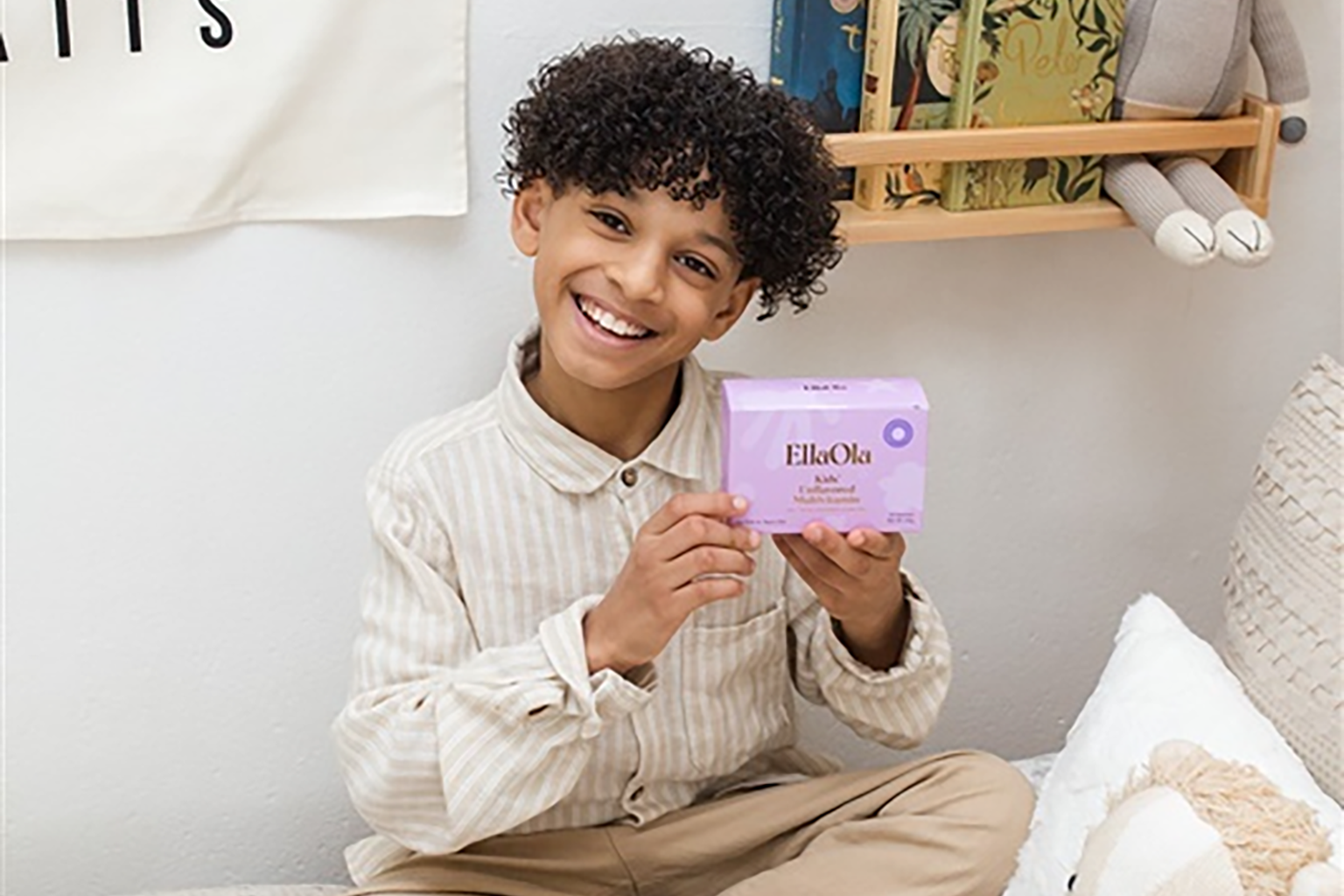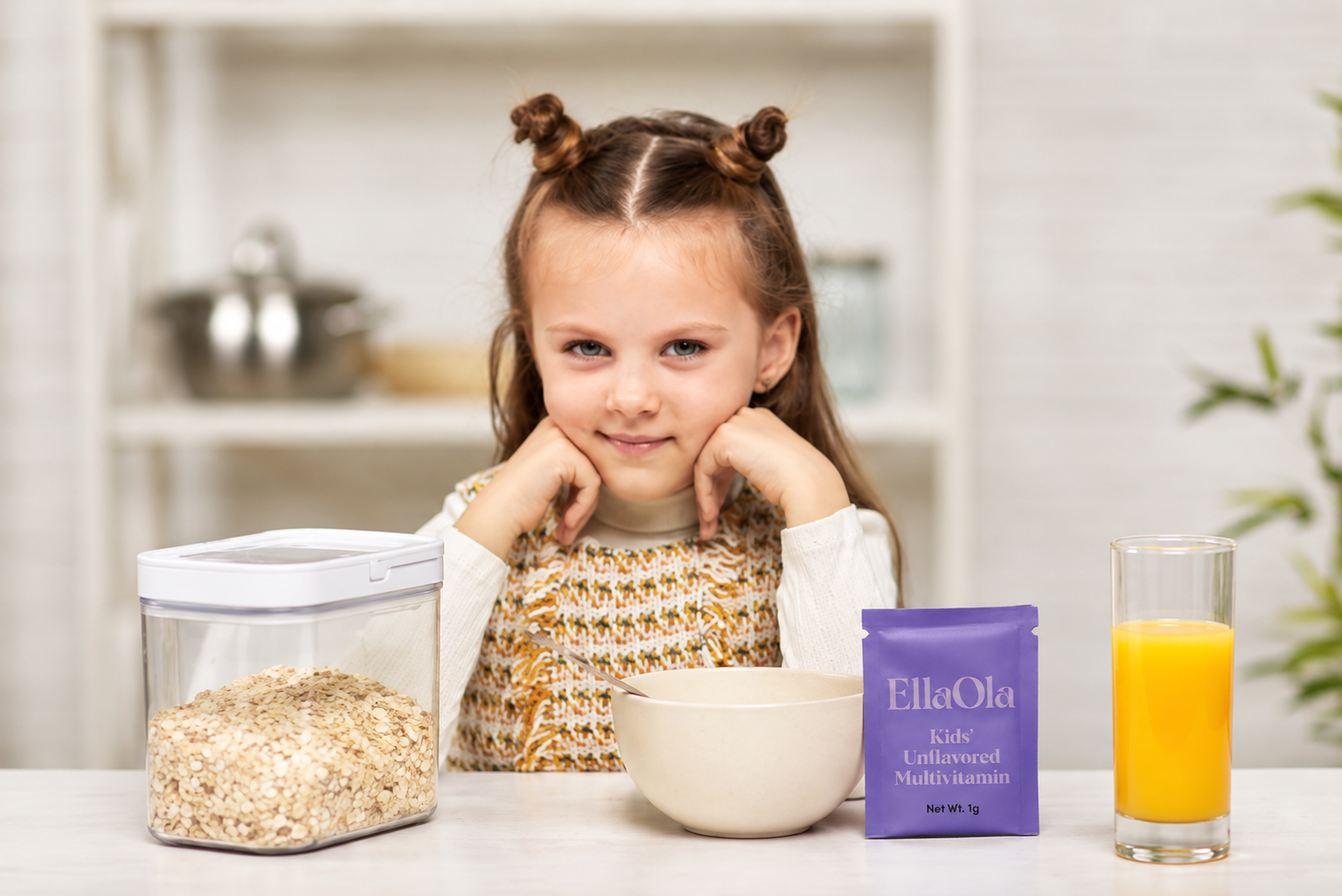

Choosing a kids’ multivitamin means answering two questions: what does it provide, and will your child actually take it? The label matters, but so does finding a format that fits your family’s routine.
At EllaOla, we developed tasteless powder multivitamins with pediatricians and pediatric dietitians to bring those priorities together. Here’s what to look for, how the formats compare, and where our approach fits.
Best Multivitamin for Kids: The Short Answer
The best multivitamin for kids helps fill nutritional gaps with amounts appropriate for their age, in a format they can take consistently. Look for clear nutrient amounts, independent testing, and ingredients that fit your child’s needs. Then consider practical differences such as added sugar, taste, and how each serving is measured.
We built our unflavored multivitamins around those checks. Each serving is one tasteless, colorless stick pack that stirs into yogurt or oatmeal, with zero added sugar or artificial sweeteners, and every production batch is tested for heavy metals. Which formula fits depends on your child:
-
Picky eater or limited diet: an age-appropriate, unflavored multivitamin powder formula that mixes into familiar foods.
-
Toddler (2 to 3): a formula made for toddlers, with the age range on the label to match.
-
Vegan, vegetarian, or food allergies: check B12, iron, zinc, and the allergen statement first.
-
Iron: add it separately when your child's diet or your pediatrician's bloodwork points to it.
-
Varied diet with no concerns: your child may not need a multivitamin at all.
Which Kids Benefit From a Multivitamin
Food comes first. The American Academy of Pediatrics (AAP) says a healthy child eating a well-balanced diet gets what they need from meals, with no vitamin supplement needed on top of the recommended daily amounts.
"Well-balanced" describes a good week of meals, though, and some kids spend months rotating through five foods. When it's difficult to get your child to consistently eat a varied diet, a multivitamin can help fill everyday nutritional gaps.
In its guidance for toddlers, the AAP notes that some kids may need a vitamin or mineral supplement when family eating habits limit the food groups available, like in a vegan household. Beyond that, the kids who often need a closer look:
-
Picky or selective eaters whose list of accepted foods stays short for months
-
Vegan or vegetarian kids, whose diets can run short on B12, iron, and zinc
-
Kids with food allergies that limit a food group, like a dairy-free child missing a main source of calcium and vitamin D
-
Kids with absorption or medical conditions, whose supplement plan belongs with their pediatrician
Some gaps are common well beyond picky eaters. The federal advisory committee's scientific report for the 2025 Dietary Guidelines named vitamin D, calcium, potassium, and fiber as nutrients of public health concern for Americans ages 1 and up.
It found that 96% of people in that age group get less vitamin D from food and drinks than the average daily requirement, and 46% get less calcium. Those are population figures, so they show how common the gaps are without telling you whether your own child is low.
A multivitamin won't supply fiber, so fruit, vegetables, and whole grains still carry that one. The AAP also suggests checking with your pediatrician before starting a vitamin supplement. For the longer version of this question, read how to tell whether your child needs a multivitamin.
What to Look For on the Label
The front of the box shows the highlights a company most wants you to see. Turn it over, and the Supplement Facts panel tells you which nutrients are inside, how much of each, and in what form.
1) Which Nutrients It Covers and How Much
For kids, start by finding vitamin D, zinc, B12, folate, iodine, vitamin A, and vitamin C, and note whether iron is included (more on that below). Calcium and magnesium matter too. Check the milligrams listed for calcium before counting on a multivitamin to cover it.
Next, read the % Daily Value column carefully. Daily Values are set for broad age groups, and they can run high for a small child. For B12, the Daily Value is 2.4 mcg for everyone age 4 and older, adults included, while the NIH Office of Dietary Supplements puts the recommended amount for a 4- to 8-year-old at 1.2 mcg.
So a label showing 100% DV of B12 gives a kindergartner double the recommended amount. Compare each dose to the recommended dietary allowance (RDA) for your child's age, which the NIH Office of Dietary Supplements lists by age group.
Bigger numbers aren't a mark of quality. The AAP warns that megadoses of vitamins such as A, C, and D can cause toxic symptoms. Vitamin D and iron also have set upper limits for kids.
According to the NIH Office of Dietary Supplements, the upper limit for vitamin D in kids depends on age: 2,500 IU (63 mcg) for ages 1 to 3, 3,000 IU (75 mcg) for ages 4 to 8, and 4,000 IU (100 mcg) for ages 9 and up.
For iron, the NIH Office of Dietary Supplements lists the upper limit as 40 mg a day through age 13 and 45 mg a day for teens 14 and older. A label full of 300% and 500% figures deserves a second look, and your pediatrician can tell you whether those amounts make sense for your child.
Nutrient counts vary between products, even within one brand: our Kids' Essential Unflavored Multivitamin lists 19 essential vitamins and minerals plus 15 organic fruits and veggies, and other formulas list more or fewer. Look past the count to which nutrients are inside and how much of each.
2) Nutrient Forms, Including Methylated Vitamins
Many vitamins come in more than one form, and the panel names the form in small print. Vitamin D appears as D3 or D2. Both raise vitamin D levels in the blood, and the NIH Office of Dietary Supplements notes that D3 may push them higher and keep them there longer.
Folate has three names to know. Folate is the form in food, folic acid is the form added to fortified foods and many supplements, and methylfolate is another supplement form.
B12 has a similar split. Cyanocobalamin is the form you'll see most often, and methylcobalamin is another option. According to the NIH Office of Dietary Supplements, there's no evidence that the body absorbs one form better than another.
Some parents look for methylated folate and B12 because of MTHFR, a gene some people carry a variant of. We use methylated B vitamins in our multivitamins.
The CDC says people with an MTHFR variant can still process all types of folate, folic acid included. If MTHFR comes up in your child's health history, talk it through with your pediatrician.
3) What to Leave Out
The ingredients a formula skips matter as much as the ones it lists. Watch for these on the ingredient list:
-
Added sugar and sugar alcohols, which show up in many gummies
-
Artificial dyes, flavors, and sweeteners
-
The top 9 allergens (milk, eggs, fish, shellfish, tree nuts, peanuts, wheat, soybeans, and sesame), plus gluten if your child needs to avoid it
-
Proprietary blends that list herbs or extras without saying how much of each is inside
Our supplements have zero added sugar or artificial sweeteners and no fillers, artificial colors, or preservatives, and our kids' supplements are formulated free from the top 9 common food allergens. For a fuller walkthrough of ingredient lists, see our guide to reading a kids' vitamin label.
4) Third-Party Testing
The FDA doesn't approve vitamins for safety or effectiveness before they go on sale. Keeping the product safe and the label accurate is the manufacturer's job.
An independent seal tells you an outside organization has tested the product. USP Verified and NSF Contents Certified both check that a product contains what the label says and doesn't contain harmful levels of certain contaminants, like heavy metals. Clean Label Project certification focuses on screening for contaminants such as heavy metals and pesticides.
Our multivitamins are Clean Label Project™ certified and Purity Award winners. Each production batch of our multivitamins undergoes comprehensive testing for heavy metals such as lead, arsenic, cadmium, and mercury by independent, third-party labs.
Gummy vs. Chewable vs. Liquid vs. Powder
The format often decides whether your child takes a vitamin at all.
|
Format |
How it's taken |
Flavor and sweeteners |
Dosing |
For picky eaters |
Main drawback |
|---|---|---|---|---|---|
|
Gummy |
Chewed |
Flavored; many contain added sugar |
Pre-portioned, often more than one gummy per serving |
Easy to accept, since many taste like candy |
Added sugar in many, and kids can mistake them for candy |
|
Chewable |
Chewed |
Usually flavored; some sweetened |
Pre-portioned tablet |
Taste and texture put some kids off |
Your child has to be ready to chew it and like the taste |
|
Liquid or drops |
From a dropper or spoon |
Often flavored; some sweetened |
Parent measures each dose |
Some kids resist the taste |
Taste, measuring accuracy, and some formulas stain |
|
Powder |
Mixed into food or drink |
Flavored or unflavored |
Pre-measured packet or a measured scoop |
Unflavored powders hide in food |
Needs something to mix into |
Whatever the format, follow the age range printed on the label, and check whether iron is listed on the panel if that matters for your child.
Gummies are the easiest sell because many taste like candy, and that's also their weak spot. Many carry added sugar, some take more than one gummy for a full serving, and a bottle of them can look like a treat to a curious toddler. If you choose gummies, read the sugar line and store the bottle up high.
Chewables are pre-portioned tablets, some sweetened and some not, so check the sugar line here too. They're made for kids who can chew a tablet thoroughly, so go by the age range on the label and whether your child is ready. Texture is the other hurdle: a chalky or strongly flavored tablet can get spit out.
Liquids and drops make it easy to give a small dose, which is why parents of toddlers often reach for them. The downsides are taste, stains from some formulas, and accuracy, since every dose depends on how carefully it gets measured.
Powders come in pre-measured packets or in a tub with a measuring scoop, and you stir them into food or drink. With no tablet or gummy to chew, they help kids who refuse gummies, chewables, and syrups. The trade-off is that a powder needs something to go into, and a flavored or gritty one can change how that food tastes.
Our unflavored multivitamins are tasteless and colorless, and each serving comes in its own pre-measured stick pack, so there's nothing to scoop and no tablet or gummy to chew.
One stick pack disappears into yogurt, applesauce, a smoothie, or a cup of milk, and it can be mixed into warm foods like oatmeal or mac and cheese. Parents.com named our Kids' Essential Unflavored Multivitamin the best powdered kids' multivitamin, according to dietitians, and The Bump named us its best powder toddler vitamin.
For how each format suits picky eaters versus sensory-sensitive kids, see our powder, gummy, and liquid format comparison.
Matching a Multivitamin to Your Child
With the label and format settled, the choice usually comes down to your child's age, how they eat, and whether iron is on your pediatrician's radar.
1) By Age

Toddlers (2 to 3): Choose a formula made for this age, and don't split a kids' or adult product in half to make it fit. Our Toddlers' Essential Unflavored Multivitamin is designed for ages 2 to 3.

Kids (4 to 11): Our Kids' Essential Unflavored Multivitamin is designed for ages 4 to 11, at one stick pack daily.

Teens (12 to 17): Teens have their own nutrient needs, so we make a separate Teens' Essential Unflavored Multivitamin for them.
2) For Picky Eaters
Picky eating brings two problems at once: the gaps in what your child eats, and a child who's just as selective about the vitamin. A formula can pass every label check and still sit in the cabinet.
That's why we point parents of selective eaters toward formats that hide in foods their kids already accept, like the oatmeal or yogurt that shows up every morning. We designed our multivitamins for picky eaters around that exact problem: one tasteless stick pack, stirred into a food your child already eats.
3) For Vegan, Vegetarian, or Allergy Diets
B12 comes naturally only from animal foods, so kids who eat vegan or vegetarian need it from somewhere else. The NIH Office of Dietary Supplements notes that B12-fortified foods, like some breakfast cereals and nutritional yeasts, and B12 supplements can help vegans and vegetarians get enough. Zinc and iodine deserve a check on the panel too.
Iron needs are higher on a plant-based diet. The NIH Office of Dietary Supplements notes that people eating vegetarian need 1.8 times as much iron as people who eat meat, because the body absorbs iron from meat more easily than iron from plants.
Also confirm the product itself is vegan. Some gummies are made with gelatin, and the source of vitamin D3 varies. Our supplements are vegan. For other allergies, read the allergen statement against your child's specific list.
4) With or Without Iron
According to the AAP, iron deficiency does show up in some young children, and a toddler who drinks a lot of milk can lose interest in the foods that supply iron. Picky eating on its own isn't a reason to add iron, though.
Iron has an upper limit, so it belongs in the routine when your child's diet or your pediatrician's bloodwork points to it. The base formulas of our Toddlers' and Kids' multivitamins don't include iron.
Iron comes as a separate sachet, our Tasteless Iron with Vitamin C, on its own or bundled with our multivitamins. Vitamin C boosts absorption of iron, and keeping the two separate means iron goes into the routine only when you and your pediatrician decide it should.
Safety, Dosing, and Storage
Keep every vitamin out of reach, gummies most of all, since many look and taste like candy. Follow the storage guidelines for your vitamins of choice. Federal rules require iron-containing supplements in tablet, capsule, or caplet form to carry a warning about accidental overdose in young children.
Count everything your child takes. A multivitamin, a fortified cereal, and a separate vitamin D drop can add up past the upper limit. The NIH Office of Dietary Supplements notes that vitamin D toxicity almost always comes from too much taken as supplements.
Follow the label for your child's age band, and keep adult products for adults. For our products, that's one stick pack daily. Bring the product label to your child's next checkup so your pediatrician can see exactly what's in it.
Before You Buy a Kids' Multivitamin
Start with what your child eats. If the diet is varied and your pediatrician has no concerns, food may be covering it. If there are gaps, turn the box over, find the nutrients your child's diet is missing, compare each amount to the RDA for their age, and check that nothing runs past the upper limit.
Then check what's left out (added sugar, dyes, the top 9 allergens, proprietary blends) and look for an independent testing seal. Pick the format your child will take every day, and add iron only when their diet or bloodwork points to it.
How Our Multivitamins Meet These Checks
EllaOla Kids’ Essential Unflavored Multivitamin brings together 19 essential vitamins and minerals in a tasteless, colorless powder developed with pediatricians and pediatric dietitians. It mixes into familiar foods and drinks, with zero added sugar, no artificial sweeteners, and no tablet or gummy to chew.
Each daily serving comes in a pre-measured stick pack. Our kids’ formula is made without the top 9 common food allergens and every production batch is independently tested for heavy metals.
Explore our Kids' Essential Unflavored Multivitamin for ages 4 to 11, our Toddlers' Essential Unflavored Multivitamin for ages 2 to 3, or our full multivitamin collection, and add our Tasteless Iron with Vitamin C if your pediatrician recommends it. Our multivitamins are HSA/FSA eligible when purchased through Truemed and come with a 45-day money-back guarantee.